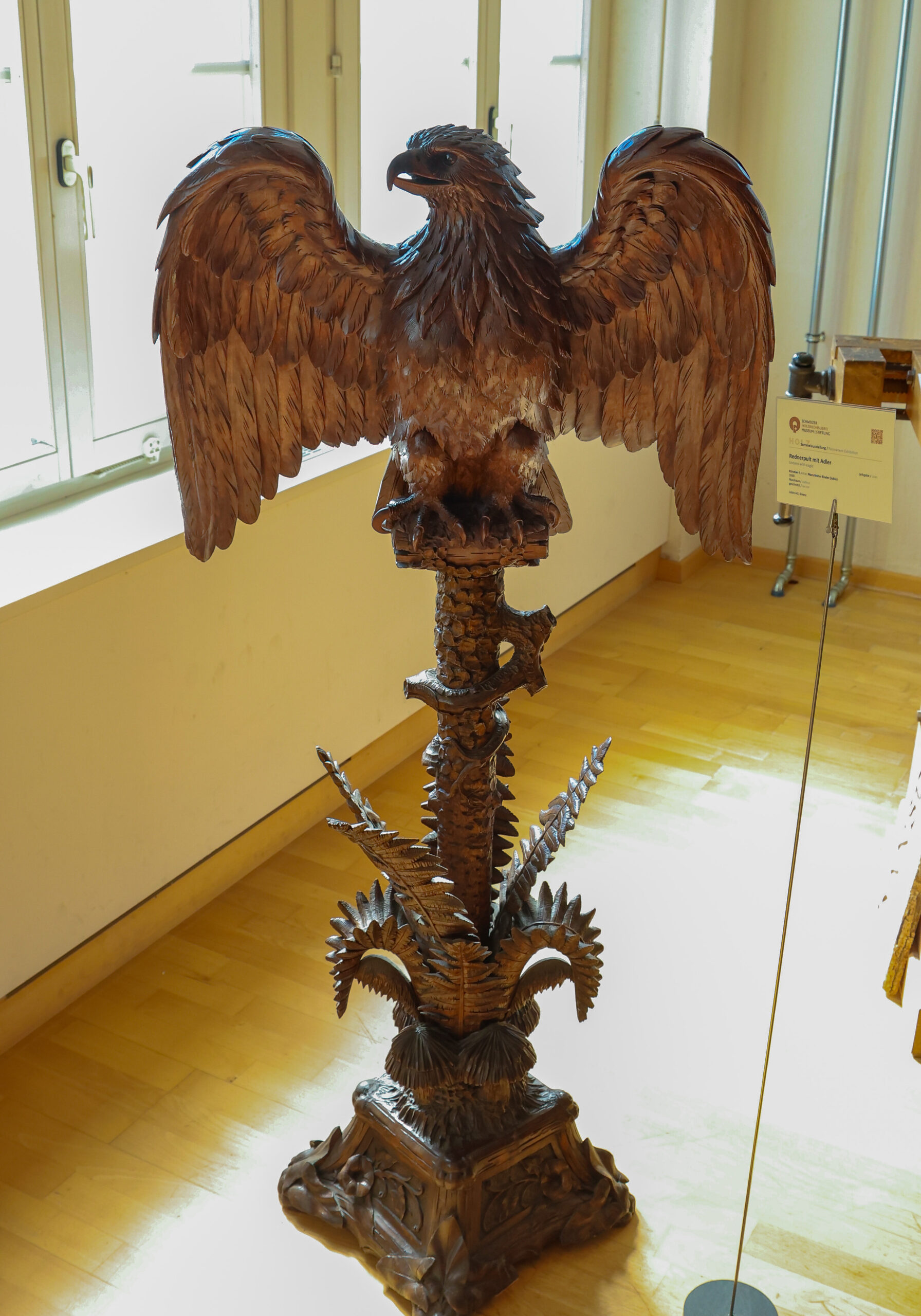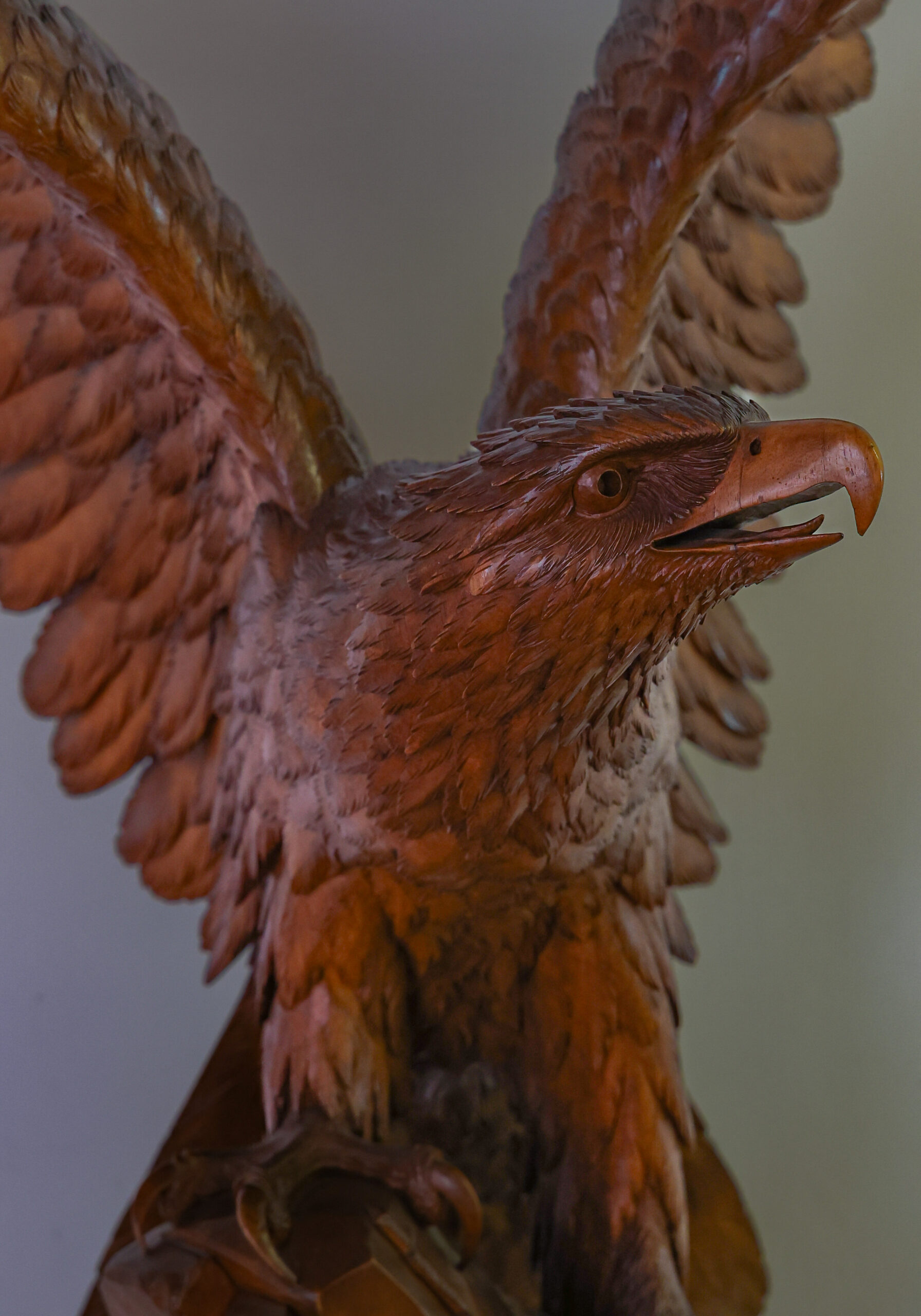
Steinadler / 21

Holzart

Nussbaum

Arbeitstechnik

Geschnitzt

Artist

Alfred Stähli (1882 – 1972)

Herstellungsjahr

um 1940

Beschrieb

Steinböcke, Gämsen, Adler und Hirsche gehören zu den beliebten Motiven der Brienzer Tierfiguren. Ende des 19. Jahrhunderts ergänzen Elefanten, Affen und Löwen das Sortiment.

Gemäss Berichten aus den 1860er Jahren schnitzten die Brienzer Holzbildhauer schon früh vielerlei Wild- und Haustiere. Jagdszenen seien sehr verbreitet, berichtet zum Beispiel Kantonsbaumeister Friedrick Salvisberg. Der Reiseschriftsteller Hermann Alexander von Berlepsch beobachtet, dass die Tiere meist stehend und einzeln dargestellt werden, da den ungeschulten Schnitzern die Fertigkeiten für das Darstellen bewegter Gruppen fehle. Auch würden sie die Tiere den Wünschen und dem Geschmack der fremden Gäste anpassen:

„Die Schnitzer nahmen im Laufe der Zeiten wahr, dass Damen und elegante Touristen, welche für ihren Schreibsekretär, für ihren Kuriositäten-Tisch daheim eine Gemsengruppe kaufen wollten, immer denen den Vorzug gaben, welche am kokettesten mit spindeldürren Steckelbeinchen, am ballettänzerhaftesten, am blasirtesten geschnitzt waren. Die ‚Holzschnäffler’, welche recht wohl wussten, dass die Gemse derben Knochenbau, eisenfeste Schenkel und gar nicht so feenhaft zarte Spinnenbeine hat, die dem Tiere bei seinen lebensgefährlichen Sprüngen schlechte Dienste leisten möchten, zogen es vor, der Torheit der Fremden, der sublimen Geschmacksverirrung zu huldigen und eine ganz neue Spezies von Grattieren zu schaffen.“

Auch im 20. Jahrhundert wissen die Holzbildhauer ihre Produkte dem Kundengeschmack anzupassen und nehmen exotische Tiere in ihr Sortiment auf: Elefanten und Affen, Löwen und Tiger. Wenn Krisen das Geschäft erschüttern wie etwa währen der beiden Weltkriege, sind jene Schnitzer im Vorteil, die zeichnen und entwerfen können und sich nicht auf ein einzelnes Tier spezialisiert haben.


Aigle royal / 21

Essence de bois

Noyer

Technique de travail

Sculpté

Artiste

Alfred Stähli (1882 – 1972)

Année de fabrication

environ 1940

Description

Les bouquetins, les chamois, les aigles et les cerfs comptent parmi les motifs les plus appréciés des figures animales de Brienz. À la fin du XIXe siècle, des éléphants, des singes et des lions viennent compléter l’assortiment.

Selon des rapports datant des années 1860, les sculpteurs sur bois de Brienz réalisaient déjà très tôt une grande variété d’animaux sauvages et domestiques. Les scènes de chasse étaient très répandues, comme le rapporte par exemple l’architecte cantonal Friedrich Salvisberg. L’écrivain de voyage Hermann Alexander von Berlepsch observe que les animaux sont le plus souvent représentés debout et individuellement, les sculpteurs non formés ne possédant pas les compétences nécessaires pour représenter des groupes en mouvement. De plus, ils adaptaient les animaux aux souhaits et au goût des visiteurs étrangers :

« Au fil du temps, les sculpteurs constatèrent que les dames et les touristes élégants, qui souhaitaient acheter un groupe de chamois pour leur secrétaire ou leur table de curiosités à domicile, préféraient toujours ceux qui étaient sculptés de la manière la plus coquette, avec des pattes fines comme des baguettes, les plus proches de danseurs de ballet, les plus raffinés. Les “renifleurs de bois”, qui savaient pourtant très bien que le chamois possède une ossature robuste, des membres solides comme le fer et nullement des pattes fragiles de type arachnéen qui lui rendraient ses sauts périlleux impossibles, préféraient néanmoins céder à la folie des étrangers, à cette subtile déviation du goût, et créer ainsi une toute nouvelle espèce d’animaux alpins. »

Au XXe siècle également, les sculpteurs sur bois savent adapter leurs produits aux goûts de la clientèle et intègrent des animaux exotiques à leur assortiment : éléphants, singes, lions et tigres. Lorsque des crises, comme celles des deux guerres mondiales, ébranlent le commerce, les sculpteurs capables de dessiner et de concevoir leurs propres modèles, et ne se limitant pas à un seul animal, sont avantagés.

Golden eagle

Type of wood

Walnut

Working method

Carved

Artist

Alfred Stähli (1882 – 1972)

Year of manufacture

about 1940

Description

Ibexes, chamois, eagles, and deer are among the most popular motifs in Brienz animal carvings. At the end of the 19th century, elephants, monkeys, and lions were added to the range.

According to reports from the 1860s, the woodcarvers of Brienz were already creating a wide variety of wild and domestic animals at an early stage. Hunting scenes were very common, as noted, for example, by the cantonal architect Friedrich Salvisberg. The travel writer Hermann Alexander von Berlepsch observed that animals were mostly depicted standing and individually, since untrained carvers lacked the skills to represent moving groups. They also adapted the animals to the wishes and tastes of foreign visitors:

“Over time, the carvers noticed that ladies and elegant tourists, who wished to buy a group of chamois for their writing desk or curiosity table at home, always preferred those that were carved in the most coquettish manner, with spindly, stick-like legs, resembling ballet dancers, and appearing the most refined. The ‘wood sniffers’, who knew perfectly well that the chamois has a sturdy bone structure, iron-strong limbs, and certainly not delicate, spider-like legs that would serve it poorly in its life-threatening leaps, nevertheless chose to indulge the folly of foreign visitors, this subtle distortion of taste, and thus created an entirely new species of alpine animals.”

In the 20th century as well, woodcarvers continued to adapt their products to customer tastes, incorporating exotic animals into their range: elephants, monkeys, lions, and tigers. During times of crisis, such as the two World Wars, those carvers who were able to draw and design their own models, and who were not limited to a single animal, had a clear advantage.

Category
Sammelausstellung